The Complexity Tax: When Multi-Region Is Not Worth It
The Complexity Tax: When Multi-Region Is Not Worth It
The Symptom
A startup with 200,000 monthly active users, all in the United States, presents their architecture review. The system runs in us-east-1. Availability over the past year: 99.93%. The CTO’s proposal: deploy to eu-west-1 “for better availability and future international expansion.”
The team spends four months building multi-region. Deployments now take 45 minutes instead of 12. A schema migration brings down the EU subscriber for 3 hours because the migration was applied to the publisher first and the subscriber choked on the schema mismatch. An incident in month two turns into a 4-hour replication debugging session. Three engineers spend 20% of their time on cross-region operational overhead.
After six months, the EU region serves zero production traffic. It exists as a warm standby that has never been activated. Availability: 99.91%. Lower than before. The replication incidents dragged it down.
The Cause
Multi-region is sold as an availability improvement. For most systems, it is an availability risk. The added complexity of data replication, coordinated deployments, and cross-region debugging introduces new failure modes that would not exist in a single-region deployment.
The decision framework has three conditions. All three must be true.
Condition 1: Regulatory Data Residency
GDPR Article 44-49 restricts transferring EU personal data outside the EU without adequate safeguards. If European riders’ personal data (name, location history, payment details) must stay in the EU, multi-region is a legal requirement, not an engineering choice.
Test: Does your legal team require data residency in specific jurisdictions? If no, condition 1 fails.
Condition 2: Latency SLO Violated for >20% of Users
Single-region latency exceeds the SLO for a significant portion of users. “Significant” means more than 20%. If 3% of users experience high latency, a CDN or edge caching solves it cheaper.
Test: Measure p99 latency from each geographic segment. If more than 20% of users exceed the SLO, condition 2 passes.
Condition 3: Business Can Fund 2-3x Cost
Multi-region costs more than double. Not 2x. The overhead of monitoring, replication infrastructure, coordinated deployments, and additional on-call coverage pushes the actual multiplier to 2.3-2.5x.
Test: Can the business sustain this cost for at least 18 months? If the funding is uncertain, condition 3 fails.
Decision Matrix:

Regulatory?  Latency SLO    Funded?    Decision
                violated?
No           No             No         Single-region, multi-AZ
No           No             Yes        Single-region, multi-AZ
No           Yes            Yes        CDN + edge caching first
Yes          No             No         Legal problem, not eng
Yes          No             Yes        Multi-region (regulatory)
Yes          Yes            Yes        Multi-region (justified)
The Baseline
The Alternative: Multi-AZ in a Single Region
Before paying the multi-region complexity tax, exhaust what a single region offers. AWS us-east-1 has 6 availability zones. Each AZ is a physically separate data center with independent power, cooling, and networking. Deploying across 3 AZs provides zone-level fault tolerance without any data replication challenges.
// SCALED: Multi-AZ deployment configuration
// (single-region, no replication complexity)
@Configuration
public class MultiAZConfig {

    // PostgreSQL: primary in AZ-a, synchronous replica
    // in AZ-b, async replica in AZ-c
    @Bean
    @Primary
    public ConnectionFactory primaryDataSource() {
        // RDS Multi-AZ: automatic failover between AZs
        // Failover time: 15-30 seconds
        // Zero data loss (synchronous replication within
        // the region)
        return ConnectionFactories.get(
            "r2dbc:postgresql://rides-primary.us-east-1"
            + ".rds.amazonaws.com:5432/rides");
    }

    // Read replicas in different AZs for read scaling
    @Bean("readReplica")
    public ConnectionFactory readReplicaDataSource() {
        return ConnectionFactories.get(
            "r2dbc:postgresql://rides-replica.us-east-1"
            + ".rds.amazonaws.com:5432/rides");
    }
}
# SCALED: Kubernetes deployment spread across AZs
apiVersion: apps/v1
kind: Deployment
metadata:
name: rider-api
spec:
replicas: 6
template:
spec:
topologySpreadConstraints:
- maxSkew: 1
topologyKey: topology.kubernetes.io/zone
whenUnsatisfiable: DoNotSchedule
labelSelector:
matchLabels:
app: rider-api
# 6 replicas across 3 AZs = 2 per AZ
# Losing one AZ loses 2 pods (33%)
# 4 remaining pods handle the loadCost Comparison
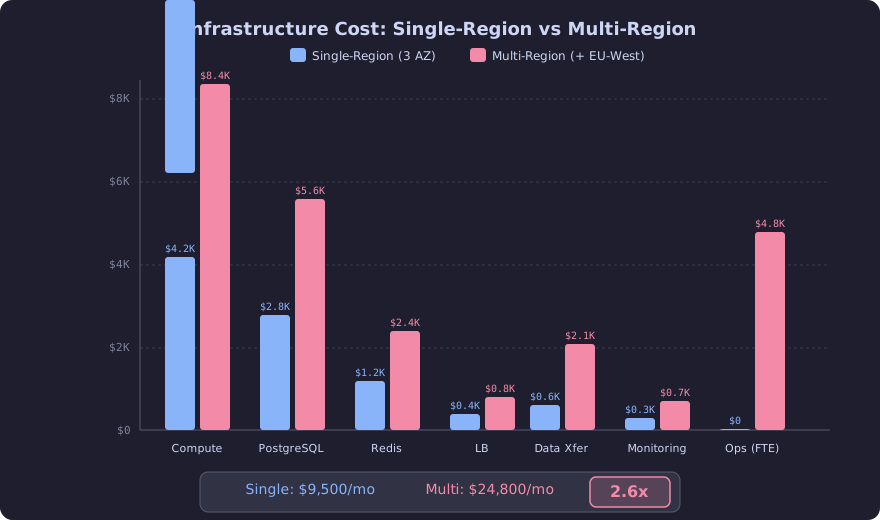
The cost comparison reveals that multi-region deployment is not a simple doubling. Compute and database costs double as expected, but cross-region data transfer jumps 3.5x and the 0.4 FTE operational overhead ($4,800/mo) for replication lag investigations, coordinated deployments, and cross-region debugging adds a hidden cost that infrastructure calculators miss. The total 2.6x multiplier—from $9,500/mo to $24,800/mo—means this decision must be justified by revenue, regulatory requirements, or latency SLOs that single-region cannot meet.
The 2.6x is not a typo. Cross-region data transfer is expensive. Monitoring doubles. And the 0.4 FTE of operational overhead accounts for the engineer-hours spent on replication lag investigations, coordinated deployments, and cross-region incident debugging.
The Fix
The fix is knowing when NOT to build it. For the startup with 200,000 US-only users:
// SCALED: Multi-AZ health check that validates
// zone distribution
@RestController
@RequestMapping("/admin")
public class InfraHealthController {

    @Value("${EC2_AVAILABILITY_ZONE:unknown}")
    private String availabilityZone;

    @GetMapping("/zone")
    public Map<String, String> zoneInfo() {
        return Map.of(
            "zone", availabilityZone,
            "region", availabilityZone
                .substring(0, availabilityZone.length() - 1)
        );
    }
}
Maintenance Burden Over 12 Months
Track the actual cost of multi-region operations:
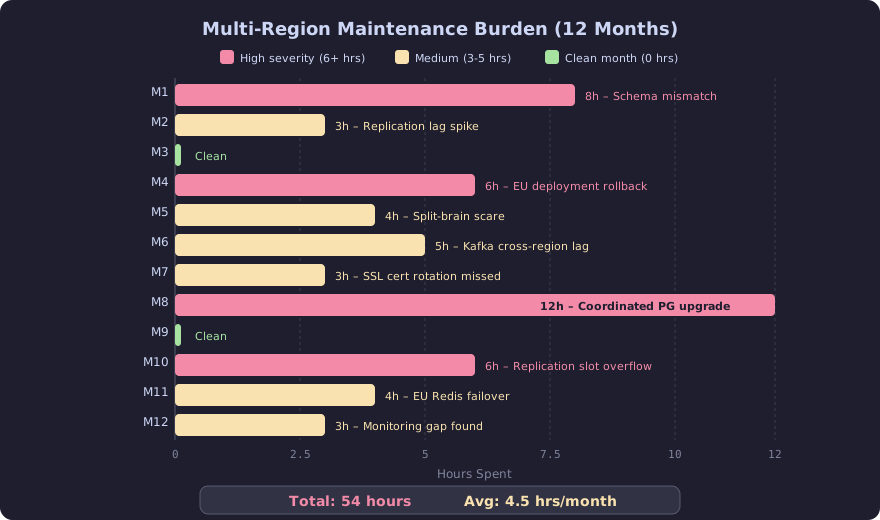
The maintenance burden tells the real story of multi-region operations. Over 12 months, the team spent 54 hours—4.5 hours per month on average—handling incidents that would not exist in a single-region deployment. The worst month (Month 8) consumed 12 hours for a coordinated PostgreSQL upgrade across regions. Only two months were clean. High-severity incidents like schema mismatches, deployment rollbacks, and replication slot overflows each consumed a full engineer-day or more.
The Ride-Hailing Decision
For the ride-hailing platform:
- Condition 1 (Regulatory): YES. GDPR requires EU data residency.
- Condition 2 (Latency): YES. 28% of users (EU riders) exceed the 300ms p99 SLO.
- Condition 3 (Funding): YES. EU revenue justifies the cost.
Decision: Multi-region is justified.
For the startup with 200k US users:
- Condition 1: NO. No international users, no data residency requirement.
- Condition 2: NO. All users in the US, p99 from west coast is 180ms.
- Condition 3: Irrelevant (first two conditions failed).
Decision: Single-region, multi-AZ. Revisit in 12 months.
The Proof
Locust: Multi-AZ Failover (Single-Region)
# SCALED: Locust test during AZ failure simulation
from locust import HttpUser, task, between, events
import time

class AZFailoverUser(HttpUser):
    wait_time = between(0.2, 0.5)
    host = "http://rider-api.us-east-1.internal"

    @task(5)
    def book_ride(self):
        self.client.post("/api/rides/book", json={
            "riderId": "rider-az-test",
            "pickupLat": 40.7128, "pickupLng": -74.0060,
            "dropoffLat": 40.7580, "dropoffLng": -73.9855,
            "zoneId": "manhattan-midtown"
        })

    @task(3)
    def fare_estimate(self):
        self.client.get(
            "/api/fares/estimate?zoneId=manhattan-midtown")
Multi-AZ Failover Test (kill 1 of 3 AZs):
Time to recover: 15 seconds
Error rate during: 0.1% (requests in-flight to dead AZ)
Error rate after: 0.00%
p99 during failover: 350ms (brief spike)
p99 after recovery: 185ms
Multi-Region Failover Test (kill entire US-East):
Time to recover: 60-120 seconds (DNS TTL)
Error rate during: 2.1% (DNS caching, in-flight requests)
Error rate after: 0.03%
p99 during failover: 1200ms (DNS re-resolution)
p99 after recovery: 90ms (EU riders now local)Multi-AZ failover is faster, cleaner, and cheaper than multi-region failover. For availability, multi-AZ wins. Multi-region is justified by data residency and latency requirements, not by availability. Do not confuse the two.
Availability comparison (12 months):
  Single-region, multi-AZ:  99.95% (4.38 hours downtime)
  Multi-region (active):    99.91% (7.88 hours downtime)

The multi-region system had MORE downtime because
replication incidents and coordinated deployment failures
introduced failure modes that do not exist in single-region.
Multi-region is a tool for specific problems: data residency and geographic latency. It is not a default architecture. It is not an availability strategy. If your users are in one geography and your data has no residency requirements, the complexity tax is pure cost with no return.