The Age of Direct Control: Machine Code to C
SummaryWalks through the three foundational abstraction leaps in...
Walks through the three foundational abstraction leaps in...
Walks through the three foundational abstraction leaps in computing: from raw binary to assembly mnemonics, from assembly to procedural languages like FORTRAN and C, and from direct OS interaction to standard libraries. Uses a concrete x86 assembly vs C comparison for adding two numbers, explains the PDP-11's influence on C's design as 'portable assembly,' and lays out exactly what C hides from the programmer—register allocation, calling conventions, and stack frame management—with a detailed text-based stack frame diagram.
The Age of Direct Control: Machine Code to C
Leap 1: Binary to Assembly — Giving the Machine a Vocabulary
The first abstraction in computing history was also the most psychologically important. Before assembly language, programming meant encoding instructions as raw numbers. The EDSAC, operational in 1949 at Cambridge, used a 17-bit instruction format: 5 bits for the opcode, 11 bits for the memory address, 1 bit for a length flag. Programmers memorized these bit patterns. An addition was opcode 00110. A subtraction was 00111. If you mixed them up, you didn’t get a compiler error. You got a wrong answer, silently.
Assembly language, emerging in the early 1950s, replaced numeric opcodes with mnemonics: ADD, SUB, MOV, JMP. It replaced raw memory addresses with symbolic labels. This was the first time a human word appeared in a program.
What seems like a small quality-of-life improvement was actually a philosophical shift. Assembly introduced the idea that the programmer’s mental model doesn’t need to match the machine’s binary representation. MOV EAX, 42 and B8 2A 00 00 00 are the same instruction. The assembler translates one to the other. Nothing is hidden—yet. Every assembly instruction still maps to exactly one machine instruction (with minor exceptions for pseudo-instructions). But the precedent was set: a tool stands between you and the CPU, and that tool makes choices on your behalf.
What was gained: readability, symbolic addressing, reduced errors from mistyped binary.
What was lost: almost nothing, technically. But conceptually, everything. The door was open.
Leap 2: Assembly to C — Portable Assembly and Its Discontents
The PDP-11 Connection
Dennis Ritchie and Ken Thompson didn’t design C in the abstract. They designed it for a specific machine: the PDP-11 at Bell Labs. This matters because the PDP-11’s architecture directly shaped C’s semantics.
The PDP-11 had general-purpose registers, byte-addressable memory, a hardware stack with push/pop instructions, and pointer arithmetic built into its addressing modes. C’s pointer model—where *(p + n) dereferences an address offset by n elements—maps almost directly to the PDP-11’s auto-increment addressing mode. C’s int was 16 bits because PDP-11 registers were 16 bits. The ++ and -- operators existed because the PDP-11 had auto-increment and auto-decrement addressing.
This is why C was called “portable assembly.” It wasn’t abstract—it was a thin, portable veneer over a specific hardware paradigm that happened to generalize well. When C targeted other architectures (VAX, 68000, x86), the mapping wasn’t always as clean, but it was close enough. The key trade was explicit: give up control of which registers are used and which specific instructions are emitted, and in return, get code that compiles on any architecture with a C compiler.
What the Compiler Does That You Used to Do
Consider adding two numbers and returning the result. In x86-64 assembly (Linux, System V ABI):
; int add(int a, int b)
; Arguments: a in EDI, b in ESI (System V calling convention)
; Return value in EAX

add_numbers:
    mov eax, edi       ; Copy first argument to return register
    add eax, esi       ; Add second argument
    ret                ; Return to caller

section .text
    global _start

_start:
    mov edi, 42        ; First argument
    mov esi, 18        ; Second argument
    call add_numbers   ; Call the function

    ; Exit with result as exit code
    mov edi, eax       ; Exit code = result
    mov eax, 60        ; syscall: exit
    syscall
You are making explicit decisions here: which registers hold the arguments (EDI, ESI), which register holds the return value (EAX), and how to invoke the system call to exit. You are obeying the System V calling convention—a contract that says “caller puts the first integer argument in EDI”—and you are aware that you are obeying it.
Now the identical logic in C:
int add_numbers(int a, int b) {
    return a + b;
}

int main(void) {
    int result = add_numbers(42, 18);
    return result;
}
The C version hides three categories of decisions:
Register allocation. The compiler decides which physical CPU registers hold a, b, and the return value. On x86-64 Linux, it will almost certainly follow the same System V convention (EDI, ESI, EAX), but you don’t specify this. You don’t even know it’s happening unless you read the ABI specification or disassemble the output.
Calling conventions. When you write add_numbers(42, 18), the compiler generates code to place 42 in EDI and 18 in ESI, issues a CALL instruction, and collects the result from EAX. On Windows, the same C code would place arguments in ECX and EDX instead (Microsoft x64 calling convention). The source code is identical. The generated machine code is different. You don’t control which convention is used—the compiler and target platform decide.
Stack frame management. This is the most consequential hidden mechanism, and it deserves a closer look.
The Invisible Stack Frame
When main calls add_numbers, the CPU (directed by compiler-generated code) constructs a stack frame. Here’s what the stack looks like during the execution of add_numbers:
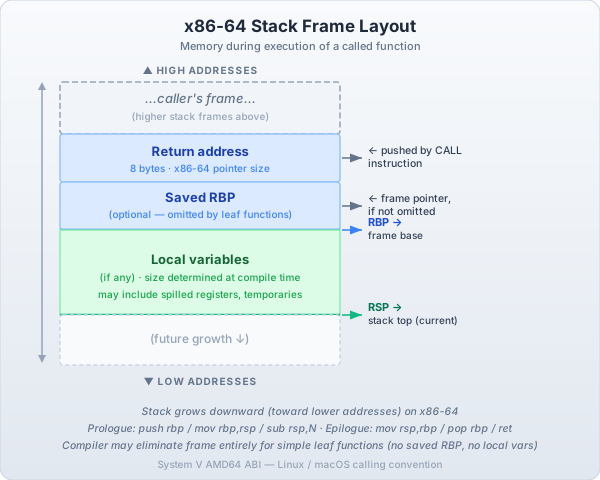
Stack frame anatomy: when main calls add_numbers, the CPU constructs a frame containing the return address (pushed by the CALL instruction), the saved frame pointer RBP (so the caller can restore its own frame), and space for local variables. RSP (stack pointer) points to the current top. RBP (base pointer) anchors the frame — arguments are at positive offsets from RBP, locals at negative offsets. An optimizing compiler may omit the frame pointer entirely (-fomit-frame-pointer), using RSP-relative addressing instead. When the function returns, the epilogue restores RSP and RBP in one instruction (leave), and ret pops the return address into RIP.
For a trivial function like add_numbers, an optimizing compiler may eliminate the frame entirely—no stack allocation, no saved registers, just a MOV + ADD + RET. But for any non-trivial function, the compiler generates a prologue and epilogue:
; Prologue (compiler-generated)
push rbp              ; Save caller's frame pointer
mov rbp, rsp          ; Establish new frame pointer
sub rsp, 16           ; Allocate space for local variables

; ... function body ...

; Epilogue (compiler-generated)
mov rsp, rbp          ; Deallocate local variables
pop rbp               ; Restore caller's frame pointer
ret                   ; Return to caller
Every C function call executes this ritual. You never write it. You never see it. But it’s there, consuming cycles and stack space. When a stack overflow occurs—recursion too deep, array too large—you’re hitting the limit of a mechanism you may have never been taught exists.
What You Lost
An assembly programmer building a performance-critical inner loop would make deliberate choices about all of this: Can I avoid the function call entirely by inlining? Can I skip the frame pointer setup (the push rbp / mov rbp, rsp pair) since I don’t need a frame base for debugging? Can I use callee-saved registers to avoid spilling to the stack?
Modern C compilers make these same decisions, and they make them well—often better than a human would. GCC and Clang with -O2 will inline small functions, omit frame pointers (-fomit-frame-pointer), and perform register allocation using graph coloring algorithms that outperform most manual attempts.
But “the compiler is usually right” is not the same as “you don’t need to understand what the compiler does.” When the compiler makes a choice that causes a performance regression—a function that shouldn’t be inlined gets inlined, increasing instruction cache pressure; a register spill in a hot loop that doubles its runtime—you need to understand the mechanism to diagnose the problem. You need to be able to read the output of objdump -d or gcc -S and recognize what went wrong.
Leap 3: Direct OS Interaction to Standard Libraries
The third leap in this era is subtler but equally important. Early C programs interacted with the operating system through direct system calls—int 0x80 on Linux, svc on ARM. The C standard library (libc) wrapped these in portable functions: printf, malloc, fopen, read, write.
This was a necessary abstraction. POSIX standardized the interface so that a C program could call open() on Linux, FreeBSD, macOS, and Solaris and expect (roughly) the same behavior. But open() hides real complexity: file descriptor tables, inode resolution, permission checks, buffer cache interaction, filesystem-specific behavior.
When printf("Result: %d\n", result) executes, here is a partial list of what happens beneath it:
- Format string parsing and argument marshaling in userspace
- Writing to an internal
FILEbuffer (not to the screen—not yet) - When the buffer fills or a newline is encountered (line-buffered stdout): a
write()syscall - Context switch from user mode to kernel mode
- Kernel copies data from user buffer to a kernel buffer
- The terminal driver interprets the byte stream
- Characters appear on your screen
Seven layers of machinery behind a five-character function name. The C programmer of the 1970s likely understood all seven. The C programmer of 2026 likely understands one or two.
This is the pattern set by the age of direct control: each abstraction was small, each was justified, and each removed a specific piece of knowledge from daily practice. The pieces were small enough that no single removal felt dangerous. But they accumulated.
The next era would accelerate this process dramatically—replacing manual memory management with garbage collection, replacing native compilation with virtual machines, and replacing physical servers with elastic cloud infrastructure. The distance between programmer and machine was about to grow by an order of magnitude.