The AI Layer: The Most Dangerous Abstraction Yet
SummaryExamines AI code generation as a recursive abstraction...
Examines AI code generation as a recursive abstraction...
Examines AI code generation as a recursive abstraction layer that produces other abstractions, explains LLM mechanics at the engineer level, demonstrates concrete failures in AI-generated code, and establishes the dependency inversion problem where engineers can't evaluate output they don't understand.
The AI Layer: The Most Dangerous Abstraction Yet
AI code generation is the fastest-growing abstraction layer in history, and it’s the most dangerous one — not because it’s AI, not because it’s new, but because it generates other abstractions. Every previous abstraction layer we’ve discussed in this book — compilers, frameworks, ORMs, container orchestrators — hides one specific domain of complexity behind one specific interface. AI code generation hides everything. It takes a natural language prompt and emits arbitrarily complex code spanning arbitrarily many abstraction layers. It’s an abstraction that produces abstractions. That’s a new kind of problem.
Let’s be precise about what this means. When you drag a component in a visual UI builder, you know you’re generating HTML and CSS. When you write a SQL query through an ORM, you know there’s a database query underneath. The abstraction boundary is visible. You can choose to look through it or not. AI code generation obliterates this boundary entirely. You type “write a Python function to connect to PostgreSQL with connection pooling,” and what comes back is code that crosses multiple layers: socket management, connection lifecycle, thread safety, error handling, resource cleanup. The model doesn’t understand any of those layers. It’s producing statistically likely sequences of tokens based on training data. And you, if you haven’t done the work of understanding those layers yourself, have no way to evaluate whether the output is competent or catastrophic.
This chapter is about understanding what’s actually happening when you use AI to write code, why the output is uniquely dangerous, and how to use these tools without them hollowing out your engineering judgment.
What a Language Model Actually Does
You need a clear mental model of what happens between your prompt and the generated code. Not a PhD-level understanding — an engineer-level one. Enough to know what the tool can’t do, which is far more important than knowing what it can.
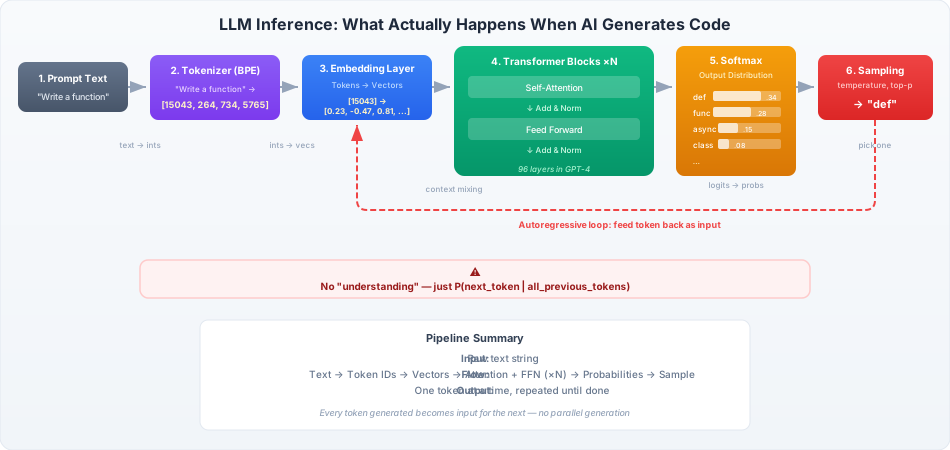
The process starts with tokenization. Your prompt isn’t processed as words or characters. It’s broken into tokens — subword units that the model was trained on. A Byte-Pair Encoding algorithm splits text into pieces based on frequency in the training corpus. The word connection might be a single token, but connection_pool_size might become connection, _pool, _size — three tokens. The model doesn’t see the semantic meaning of “connection pool size.” It sees a sequence of integer IDs corresponding to those subword pieces.
Those token IDs get mapped into an embedding space — vectors in a high-dimensional space (typically 4096 or more dimensions). These vectors encode statistical relationships between tokens learned during training. Tokens that co-occur frequently in similar contexts end up closer together in this space. This is not meaning. This is co-occurrence statistics compressed into geometry.
The core mechanism is the transformer architecture — specifically, self-attention. For each token in the sequence, the model computes attention weights over all previous tokens, determining which parts of the context are most relevant for predicting the next token. When the model has seen “def connect_to_postgres(” in its context, the attention mechanism weights tokens like “connection,” “pool,” “psycopg2,” “import” highly because they frequently co-occurred in similar positions in the training data.
Then comes the actual generation: next-token prediction. The model produces a probability distribution over its entire vocabulary (often 50,000+ tokens). It doesn’t select the “right” answer. It samples from this distribution, controlled by a temperature parameter. Temperature near zero makes it nearly deterministic (picking the highest-probability token). Higher temperature makes it more random. This is why you get different code each time you ask the same question. The model is literally rolling weighted dice.
The fundamental implication: the model has no concept of correctness. It has statistical patterns of what tokens tend to follow other tokens. When it generates a function that connects to PostgreSQL, it’s not reasoning about database connections. It’s generating token sequences that are statistically similar to PostgreSQL connection code it saw during training. The difference matters enormously.
The Accuracy Illusion
Here’s where this gets dangerous for working engineers. AI-generated code is plausible. It’s syntactically correct. It often runs. It sometimes passes tests. And plausibility is exactly the wrong metric for evaluating code that will serve production traffic.
Let’s look at a concrete case. You ask an AI assistant: “Write a Python class for PostgreSQL connection pooling using psycopg2.”
Here’s a typical response:
import psycopg2
from threading import Lock

class ConnectionPool:
    def __init__(self, dsn, min_size=5, max_size=20):
        self.dsn = dsn
        self.min_size = min_size
        self.max_size = max_size
        self._pool = []
        self._lock = Lock()
        self._initialize_pool()

    def _initialize_pool(self):
        for _ in range(self.min_size):
            conn = psycopg2.connect(self.dsn)
            self._pool.append(conn)

    def get_connection(self):
        with self._lock:
            if self._pool:
                return self._pool.pop()
            elif len(self._pool) < self.max_size:
                return psycopg2.connect(self.dsn)
            else:
                raise Exception("Connection pool exhausted")

    def return_connection(self, conn):
        with self._lock:
            self._pool.append(conn)

    def close_all(self):
        with self._lock:
            for conn in self._pool:
                conn.close()
            self._pool.clear()
This code looks competent. It has a lock for thread safety. It has min and max pool sizes. It has a cleanup method. An engineer who doesn’t deeply understand connection pooling might look at this and ship it. Here’s what’s wrong:
No connection health checks. When you pull a connection from the pool, it might be dead. The database might have terminated it due to idle timeout. The network might have dropped. This code hands you a connection object that will throw an exception on first use, and you won’t know why until it happens in production at 3 AM.
Broken pool size tracking. The max_size check uses len(self._pool) — the number of connections currently in the pool, not the total number of outstanding connections. If you check out 15 connections and have 0 in the pool, the check passes and creates a new connection. You can exceed max_size trivially. In production, this means unbounded connection creation that can exhaust database server resources during traffic spikes.
No connection timeout. When the pool is exhausted, it throws immediately. In a real system, you want to wait for a connection to be returned, with a configurable timeout. Without this, burst traffic causes cascading failures instead of graceful queuing.
No connection lifecycle management. Connections don’t live forever. You need to track connection age and retire stale connections. You need to handle connections that error out during use. This pool accumulates zombie connections over time.
No context manager protocol. Without __enter__ and __exit__, callers have to manually remember to return connections. They won’t. You’ll leak connections until the pool is exhausted and the service collapses.
This is five critical bugs in thirty lines of code. Every one of them will be invisible in development and devastating in production. Every one of them requires understanding database connection management — the exact understanding the AI can’t provide.
The Dependency Inversion Problem
This example reveals the fundamental problem with AI code generation as an abstraction layer. With every other abstraction we’ve discussed, the abstraction simplifies something you could learn to do manually. You use an ORM, but you could write SQL. You use a container orchestrator, but you could manage processes manually. The abstraction accelerates what you understand.
AI code generation inverts this relationship. It produces code in domains you may not understand at all. And when you can’t evaluate the output, you can’t evaluate the quality of the output. You’re in a dependency inversion: the consumer of the abstraction cannot assess what the abstraction produces.
Think about this structurally. In a healthy abstraction relationship, you have:
- Understanding → You know what correct output looks like
- Specification → You describe what you want precisely
- Evaluation → You verify the output meets your specification
AI code generation collapses step 1 and step 3 when you don’t understand the domain. You can’t write a precise specification because you don’t know what the constraints are (connection health checks, pool size tracking, lifecycle management). And you can’t evaluate the output because you don’t know what correct looks like.
The traditional response is “just review the code.” But review for what? If you don’t know that connection pools need health checks, you won’t notice their absence. If you don’t know about connection lifecycle management, it won’t occur to you to look for it. Code review is only effective when the reviewer has independent knowledge of the domain. AI-generated code in unfamiliar domains defeats code review by definition.
This is not a theoretical concern. It’s happening at scale, right now. Junior engineers are generating complex distributed systems code — retry logic, circuit breakers, consensus algorithms — and shipping it without the domain knowledge to evaluate its correctness. Senior engineers are reviewing it too quickly because it “looks right” and passes CI. The bugs emerge weeks or months later, in production, under load, and they’re expensive.
The Recursive Abstraction Trap
What makes AI uniquely dangerous compared to other abstraction layers is the recursion. When an ORM introduces an N+1 query problem, you always get the same N+1 query problem. You learn to recognize it. You develop pattern-matching for ORM-specific failure modes. The abstraction’s failure modes are finite and learnable.
AI-generated code can fail in any way that code can fail. The failure modes are bounded only by the space of possible bugs, which is infinite. You can’t develop pattern-matching for “bugs AI tends to write” because the bugs are different every time, in every domain, across every possible library and framework combination.
Worse, AI-generated code often introduces abstractions — wrapper classes, utility functions, helper modules — that have no basis in the actual problem domain. The model generates these because it saw similar patterns in training data, not because the problem requires them. You end up with an abstraction layer that was invented by a probability distribution, solving a problem you didn’t know you had, in a way you can’t evaluate.
The Acceleration of Abstraction Blindness
We’ve been tracing abstraction blindness throughout this book — the progressive inability to see through the layers you depend on. AI tools accelerate this process dramatically, because they short-circuit the learning that used to happen when you struggled with a problem.
Before AI code generation, learning a new domain involved friction. You’d read documentation, try things, hit errors, read stack traces, try again. This friction was productive. It built mental models. When you finally got your connection pool working, you understood why each piece was there because you’d encountered the failure that motivated it.
AI removes this friction — and removes the learning with it. You get a working connection pool on the first try, and you never encounter the failure modes that would teach you why it’s insufficient. You gain velocity at the cost of understanding. Over time, across dozens of features built this way, you’ve accumulated code you can’t debug, modify, or extend without going back to the AI. You haven’t built engineering judgment; you’ve outsourced it.
The senior engineers who learned by struggling are retiring. The junior engineers who learned by prompting are rising. What happens when the accumulated understanding in the industry drops below the level required to evaluate AI output? We find out — and the answer arrives as production incidents that nobody on the team can diagnose.
How to Use AI Without Losing Your Mind
None of this means you should stop using AI tools. That would be as absurd as refusing to use compilers because you understand assembly. The point isn’t avoidance; it’s the same point this entire book makes: understand the layer beneath the one you’re working on.
AI tools are powerful accelerators when they’re applied to patterns you already understand. You know how to write a REST endpoint, you’ve written dozens of them, you understand the routing, the serialization, the error handling. Using AI to scaffold the boilerplate saves time without costing understanding. That’s the right use case.
AI tools are dangerous when they become a substitute for learning. When you use them to generate code in domains you haven’t mastered — concurrency, cryptography, distributed consensus, connection management — you’re generating code you can’t evaluate. That’s the wrong use case.
The framework is simple:
Use AI when you could write the code yourself but it would be tedious. Boilerplate, repetitive patterns, type definitions, test scaffolding. You understand the output, so you can evaluate it.
Don’t use AI when you’re learning something new. Do the struggle. Hit the errors. Read the documentation. Build the mental model. Then, once you understand the domain, use AI to accelerate your work in it.
Always apply the explain-it-back test. After AI generates code, go line by line. Can you explain every choice? Every library import? Every error handling path? Every edge case? If you can’t explain it, you can’t ship it. Not responsibly.
The AI layer is the most dangerous abstraction yet — not because the technology is bad, but because it’s the first abstraction that tempts you to stop thinking entirely. Every previous abstraction in this book required you to at least formulate the right question. AI lets you skip even that. It gives you answers to questions you never asked, solving problems you didn’t know existed, using patterns you can’t evaluate.
The engineers who thrive in the AI era will be the ones who treat it like every other powerful tool: useful when you understand what it’s doing, dangerous when you don’t. They’ll be the ones who insist on understanding the layer beneath. They always have been.