When to Stop Using Hibernate
When to Stop Using Hibernate
The Lie
Hibernate is the standard Java persistence framework. Every serious Java application uses it. If you have problems, you are using it wrong.
The Reality
Hibernate solves a specific problem: mapping Java objects to relational tables with transparent persistence, identity management, dirty tracking, and lazy loading. When your application needs these features, Hibernate saves significant development time.
When your application fights these features, Hibernate becomes overhead. Every chapter of this book documents a way Hibernate’s abstractions leak, generate unexpected queries, consume unexpected memory, or hold connections longer than necessary. If most of your data access patterns work against Hibernate’s model, you are paying the cost of an abstraction you are not using.
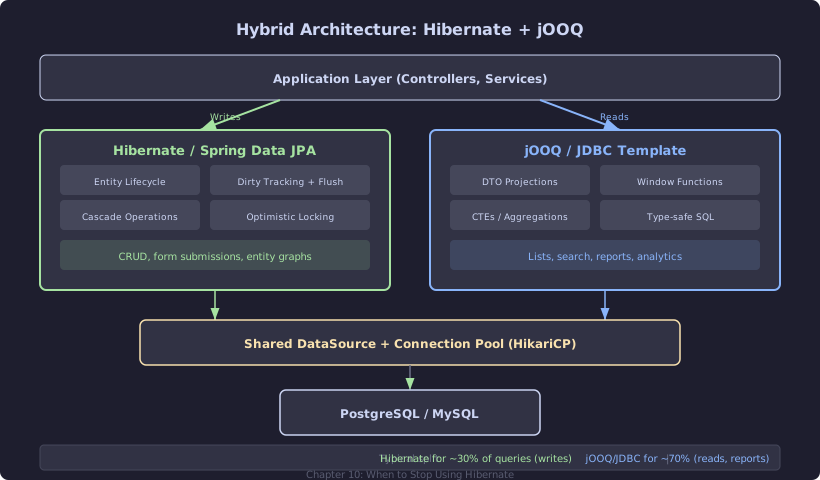
The diagram shows the recommended split: Hibernate handles writes where its entity lifecycle features (dirty tracking, cascade, optimistic locking) add real value, while jOOQ or JDBC Template handles reads, lists, and reporting queries that only load data to discard it. Both tools share the same DataSource and HikariCP pool, and both participate in Spring-managed transactions. The 70/30 annotation at the bottom reflects typical real-world usage in read-heavy CRUD applications.
Signs Hibernate is costing more than it gives:
-
Most queries are projections or reports. You load entities to read 3 of 25 fields. You never call
save()on them. The persistence context tracks entities you will never modify. -
Bulk operations dominate. You batch-insert thousands of rows. You bulk-update with SET clauses. You delete by criteria. Hibernate’s entity lifecycle model adds overhead to every one of these operations.
-
You write native SQL for most complex queries. Your application uses window functions, CTEs, lateral joins, and database-specific features that JPQL cannot express. You are using Hibernate as a worse version of JDBC with XML configuration.
-
N+1 and lazy loading are recurring production issues. You have added
@EntityGraph,JOIN FETCH, and batch fetch annotations everywhere, fighting the default behavior that Hibernate was designed around. -
Your team spends more time debugging Hibernate than writing business logic. Understanding flush timing, persistence context behavior, and proxy initialization takes deep framework knowledge. If your team does not have that knowledge, every Hibernate decision is a guess.
The Evidence
Compare Hibernate and jOOQ for a reporting query:
// Hibernate: Load entities, extract data in Java
@Transactional(readOnly = true)
public List<MonthlySalesReport> generateReport(int year) {
    List<Order> orders = orderRepository
        .findByCreatedAtYear(year);  // Full entity load

    // 50,000 Order entities loaded into persistence context
    // Each with snapshots (even readOnly stores entity refs)
    // Memory: ~100 MB
    // GC pressure: significant

    return orders.stream()
        .collect(Collectors.groupingBy(
            o -> o.getCreatedAt().getMonth(),
            Collectors.summarizingDouble(
                o -> o.getTotal().doubleValue())))
        .entrySet().stream()
        .map(e -> new MonthlySalesReport(
            e.getKey(), e.getValue().getSum(),
            e.getValue().getCount()))
        .toList();
}
// jOOQ: Write the SQL, get typed results
public List<MonthlySalesReport> generateReport(int year) {
return dsl.select(
month(ORDERS.CREATED_AT).as("month"),
sum(ORDERS.TOTAL).as("revenue"),
count().as("order_count"))
.from(ORDERS)
.where(year(ORDERS.CREATED_AT).eq(year))
.groupBy(month(ORDERS.CREATED_AT))
.orderBy(month(ORDERS.CREATED_AT))
.fetchInto(MonthlySalesReport.class);
// Generated SQL:
// select extract(month from created_at) as month,
// sum(total) as revenue,
// count(*) as order_count
// from orders
// where extract(year from created_at) = ?
// group by extract(month from created_at)
// order by extract(month from created_at)
//
// Result: 12 rows. ~1 KB. No entity management.
}// Spring JDBC Template: Manual mapping, full control
public List<MonthlySalesReport> generateReport(int year) {
return jdbcTemplate.query("""
SELECT extract(month FROM created_at) AS month,
SUM(total) AS revenue,
COUNT(*) AS order_count
FROM orders
WHERE extract(year FROM created_at) = ?
GROUP BY extract(month FROM created_at)
ORDER BY 1
""",
(rs, rowNum) -> new MonthlySalesReport(
Month.of(rs.getInt("month")),
rs.getBigDecimal("revenue"),
rs.getLong("order_count")),
year);
}The jOOQ and JDBC Template versions produce the same SQL, return the same 12 rows, use ~1 KB of memory, and create no persistence context. The Hibernate version loads 50,000 entities, uses ~100 MB, and performs the aggregation in Java that the database could have done in milliseconds.
The Fix
You do not have to choose one data access layer for the entire application.
The Hybrid Architecture
Use Hibernate for what it does well (CRUD with entity lifecycle management) and a lighter tool for what it does not (reads, reporting, bulk operations).
// Hibernate for writes: entity lifecycle, dirty tracking, cascading
@Service
public class OrderWriteService {

    @Autowired
    private OrderRepository orderRepository;

    @Transactional
    public Order createOrder(OrderRequest request) {
        Order order = new Order();
        order.setCustomerId(request.customerId());
        order.setStatus(OrderStatus.PENDING);

        for (ItemRequest item : request.items()) {
            OrderItem orderItem = new OrderItem();
            orderItem.setProductId(item.productId());
            orderItem.setQuantity(item.quantity());
            orderItem.setUnitPrice(item.unitPrice());
            order.addItem(orderItem);  // Cascade handles persistence
        }

        return orderRepository.save(order);
    }
}

// jOOQ for reads: projections, aggregations, window functions
@Service
public class OrderReadService {

    @Autowired
    private DSLContext dsl;

    public Page<OrderListDTO> findOrders(OrderFilter filter,
                                          Pageable pageable) {
        var query = dsl.select(
                ORDERS.ID,
                ORDERS.STATUS,
                ORDERS.TOTAL,
                ORDERS.CREATED_AT,
                CUSTOMERS.NAME.as("customer_name"))
            .from(ORDERS)
            .join(CUSTOMERS)
                .on(CUSTOMERS.ID.eq(ORDERS.CUSTOMER_ID));

        if (filter.status() != null) {
            query = query.where(
                ORDERS.STATUS.eq(filter.status().name()));
        }
        if (filter.minTotal() != null) {
            query = query.where(
                ORDERS.TOTAL.ge(filter.minTotal()));
        }

        int total = dsl.fetchCount(query);
        var results = query
            .orderBy(ORDERS.CREATED_AT.desc())
            .limit(pageable.getPageSize())
            .offset(pageable.getOffset())
            .fetchInto(OrderListDTO.class);

        return new PageImpl<>(results, pageable, total);
    }
}
Decision Matrix
| Use Case | Recommendation | Why |
|---|---|---|
| Single entity CRUD | Hibernate | Dirty tracking, cascading, lifecycle callbacks |
| Form submission (create/update) | Hibernate | Validation, optimistic locking, audit |
| List/search endpoints | jOOQ or JDBC Template | Projections, no entity overhead |
| Reporting/analytics | jOOQ or native SQL | Aggregations, window functions |
| Bulk import/export | JDBC batch or COPY | Hibernate adds per-entity overhead |
| Event sourcing | Skip ORM entirely | Append-only writes, projection reads |
| Microservice with 5 tables | Spring JDBC Template | Hibernate’s complexity is not warranted |
When Hibernate Is Still the Right Choice
Hibernate excels when your application:
- Performs primarily CRUD operations on individual entities or small graphs
- Relies on optimistic locking and entity lifecycle callbacks
- Benefits from the persistence context’s identity guarantee (load once, modify anywhere, flush automatically)
- Has a team with deep Hibernate knowledge
- Needs database portability (rare, but it happens)
If this describes more than half your data access, keep Hibernate. Supplement it with projections and native queries for the read-heavy paths.
When to Walk Away
If you find yourself adding @EntityGraph to every repository method, writing Hibernate.initialize() calls throughout your service layer, using StatelessSession for performance, and wrapping every read query in DTO projections, you have rebuilt half of JDBC inside Hibernate’s framework. At that point, you are paying for Hibernate’s complexity without using its features. A lighter tool gives you the same result with less ceremony and fewer surprises.
The Cost Model
| Factor | Hibernate | jOOQ | Spring JDBC Template |
|---|---|---|---|
| Startup time | 2-10s (metamodel, proxy generation) | 1-3s (code generation) | < 1s |
| Memory per query (1000 rows) | ~2 MB (entities + context) | ~200 KB (POJOs) | ~200 KB (mapped objects) |
| Learning curve | Steep (flush, proxy, cache, fetch) | Moderate (SQL-centric) | Low (SQL + RowMapper) |
| Type safety | Metamodel (optional) | Code-generated (built-in) | None |
| SQL feature coverage | ~70% via JPQL | ~95% | 100% |
| Write convenience | High (dirty tracking, cascade) | Low (explicit SQL) | Low (explicit SQL) |
| Debug transparency | Low (generated SQL, proxy magic) | High (SQL is the API) | High (SQL is the API) |
The decision is not ideological. It is economic. Count the hours your team spends fighting Hibernate versus using it. If the fighting exceeds the using, the abstraction is no longer paying for itself.