Why Your High AUC is Lying to You
SummaryA 0.97 AUC means nothing if your model...
A 0.97 AUC means nothing if your model...
A 0.97 AUC means nothing if your model sends the business backward. AUC is a rank-ordering metric that says nothing about probability estimates, nothing about the cost asymmetry of errors, and nothing about whether your offline evaluation reflects reality. This chapter dismantles the default evaluation workflow — train, call model.score(), celebrate — and replaces it with four pillars that survive contact with production: metric selection driven by business cost matrices, cross-validation strategies that respect the structure in your data, probability calibration so your model's confidence means something, and statistical testing so you know whether Model B actually beats Model A or you are chasing noise.
Why Your High AUC is Lying to You
Your model has 0.97 AUC. Your stakeholder is impressed. You deploy to production. The business loses money.
This is not a hypothetical scenario. It happens with stunning regularity, and the root cause is always the same: the metric you optimized has no direct relationship to the outcome the business cares about. AUC is a rank-ordering metric. It tells you that your model assigns higher scores to positive examples than negative ones, on average. It tells you nothing about the actual probability estimates your model produces. It tells you nothing about the cost asymmetry of your errors. It tells you nothing about whether your offline evaluation reflects the distribution your model will face in the real world.
Consider a fraud detection system. You have 10,000 transactions, 50 of which are fraudulent. A model that predicts “not fraud” for every transaction achieves 99.5% accuracy. A model with 0.97 AUC might catch 40 of the 50 fraudulent transactions — but if its threshold is wrong, it might also flag 500 legitimate transactions for manual review, each costing $20 in analyst time. Meanwhile, each missed fraud costs $5,000. The AUC number tells you none of this. The business impact is entirely determined by the threshold you pick and the cost of each error type.
Here is the math that AUC hides. At the default 0.5 threshold, total cost = (500 × $20) + (10 × $5,000) = $60,000. At an optimized threshold of 0.15, the model flags more transactions — catching 48 of 50 frauds but also flagging 1,200 legitimate ones. Total cost = (1,200 × $20) + (2 × $5,000) = $34,000. The model with the higher false positive count saves the business $26,000. AUC is identical at both thresholds. The business outcome is not.
Or consider a medical diagnostic model. A 0.95 AUC screen for a disease with 1% prevalence sounds impressive, until you realize that at a sensitivity-optimized threshold, it generates 50 false positives for every true positive. Clinicians drown in unnecessary follow-ups, patients endure unnecessary anxiety and invasive procedures, and trust in the screening program erodes. The AUC number looked excellent in the conference paper. The deployment was a failure.
This chapter replaces the default evaluation workflow — model.score(), nod approvingly, deploy — with a framework that survives contact with production.
Why Good Models Fail in Production
The gap between offline metrics and production performance has a few recurring sources. Understanding them upfront will sharpen everything that follows.
Distribution shift. Your test set is a sample of the past. Production data is the future. Customer behavior changes, product features ship, competitors launch, the economy shifts. A model trained on 2024 purchasing patterns evaluated on a held-out slice of 2024 data will look great — and may underperform badly in Q1 2025 when a new competitor enters the market. Your offline evaluation cannot detect this, but your cross-validation strategy can at least simulate it by respecting temporal ordering.
Threshold misalignment. AUC summarizes performance across all possible thresholds. In production, you pick one threshold. The model’s performance at that specific threshold is all that matters, and AUC tells you nothing about it. Two models with identical AUC can have radically different precision and recall at the operating threshold your business requires.
Feedback loops. Your model influences the data it is evaluated on. A fraud model that blocks suspicious transactions never observes whether those transactions were actually fraudulent. A recommendation model that surfaces certain items creates the engagement data that confirms those items are popular. Offline evaluation has no way to account for these self-reinforcing dynamics.
Metric-objective mismatch. You optimized log loss because sklearn defaults to it. Your business cares about revenue. Revenue depends on which customers you target, which depends on the threshold, which depends on the cost of each error type — none of which log loss captures. The model is faithfully optimizing the wrong thing.
Sample bias. Your training and test data come from the same pipeline, inheriting the same biases. If your historical data only includes customers who passed a previous screening model, you are evaluating on a biased population. Your metrics look good on this filtered sample and tell you nothing about performance on the full population you will encounter once the old screening model is removed.
Temporal leakage. Features computed from future data — aggregate statistics that include test-period observations, labels that reflect outcomes not yet visible at prediction time — inflate metrics in ways that are invisible in a standard train/test split. This is the most insidious failure mode because the code runs without error and the metrics look plausible. Only a careful audit of feature construction timestamps catches it.
The Four Pillars of Honest Evaluation
Every model evaluation you conduct should address four questions. Skipping any one of them is how you end up with a model that looks excellent on your laptop and fails in production.
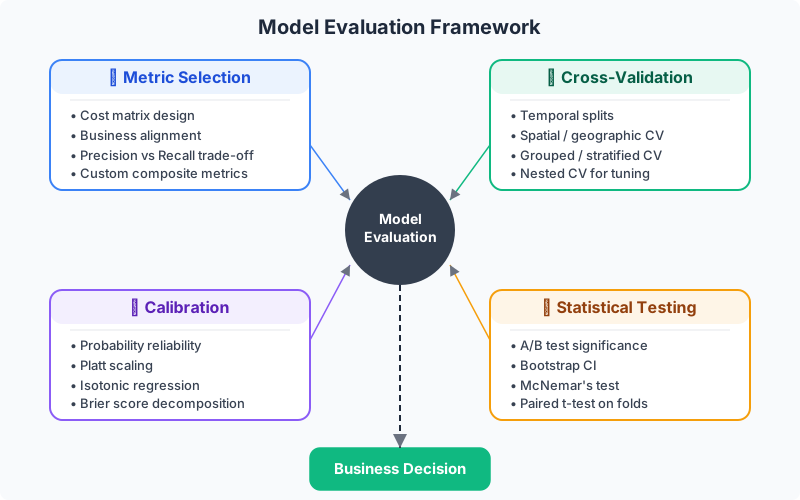
Pillar 1: Metric Selection. Are you measuring what the business actually cares about? Accuracy is meaningless on imbalanced data. AUC hides threshold decisions. RMSE penalizes large errors more than MAE — is that what you want? The right metric is determined by the cost structure of your problem, not by convention or habit. Two data scientists working on the same problem can reach different conclusions about which model is best — not because one is wrong, but because they chose different metrics that weight different error types differently.
Pillar 2: Cross-Validation Strategy. Is your evaluation estimate honest? Random k-fold on time-series data leaks the future into the past. Random k-fold on grouped data (multiple readings per patient, multiple transactions per customer) gives you an inflated estimate of generalization. Your CV strategy must respect the structure in your data, or your error estimate is a fantasy. The cruelest part: inflated CV estimates make you more confident in models that will disappoint in production.
Pillar 3: Calibration. When your model says “80% probability,” is it right 80% of the time? Tree-based models are notoriously miscalibrated — they output leaf proportions, not probabilities. If you are using probability estimates to make decisions (setting thresholds, calculating expected values, pricing risk), uncalibrated probabilities will silently corrupt every downstream decision. A model with excellent discrimination (AUC) and terrible calibration will rank-order correctly but assign meaningless probability values — and any system that uses those values will malfunction.
Pillar 4: Statistical Testing. Is Model B actually better than Model A, or are you chasing noise? A 0.3% improvement in AUC across five folds is not a signal — it is a coin flip. Without proper statistical testing, you will waste weeks fine-tuning hyperparameters, convinced you are making progress when you are fitting to the randomness in your cross-validation splits. And once you have statistical significance, you still need practical significance — a p-value of 0.001 on an effect too small to matter is a precise answer to the wrong question.
These four pillars are not independent. Choosing the right metric (Pillar 1) forces you to think about calibration (Pillar 3), because cost-based metrics depend on probability estimates. Choosing the right cross-validation strategy (Pillar 2) determines whether your statistical tests (Pillar 4) are comparing honest estimates or inflated fantasies. They form a system, and that system is what separates evaluation that protects the business from evaluation that decorates a slide deck.
What This Chapter Covers
The first section — Metrics That Matter and Cross-Validation Done Right — addresses Pillars 1 and 2. You will build custom scoring functions driven by business cost matrices, learn to pick the right metric for your problem’s error structure, and implement cross-validation strategies that respect temporal ordering, spatial correlation, and group membership. You will see, with concrete code, how naive k-fold inflates your metrics on time-series data — and how to fix it.
The second section — Calibration and A/B Testing — addresses Pillars 3 and 4. You will diagnose and fix miscalibrated probability estimates using reliability diagrams and calibration methods. Then you will move beyond offline evaluation entirely: sample size calculations, proper A/B test analysis with confidence intervals, Bayesian testing, and multi-armed bandits for adaptive experimentation.
The progression is deliberate. You cannot do A/B testing well without calibration, because your online decision thresholds depend on probability estimates. You cannot do calibration analysis without proper cross-validation, because calibration measured on leaked data is meaningless. And you cannot choose the right cross-validation strategy without knowing what metric you are evaluating — because the metric determines what “leakage” looks like.
A Note on What This Chapter Is Not
A Note on What This Chapter Is Not
This chapter does not cover model interpretability — understanding why a model makes a prediction is a separate discipline from understanding whether the prediction is any good. It does not cover production monitoring and drift detection — that belongs to the deployment chapter. And it does not cover evaluation of generative models — LLM evaluation requires different tools and was addressed in Chapter 7.
What this chapter does cover is the evaluation of predictive models: classifiers, regressors, and rankers. The tools here — cost matrices, proper cross-validation, calibration, and statistical testing — are the foundation of every serious ML evaluation pipeline. Master these, and you will recognize when a model is genuinely good versus when the metrics are flattering a mediocre model.
This chapter does not cover model interpretability — understanding why a model makes a prediction is a separate discipline from understanding whether the prediction is any good. It does not cover production monitoring and drift detection — that belongs to the deployment chapter. And it does not cover evaluation of generative models — LLM evaluation requires different tools and was addressed in Chapter 7.
What this chapter does cover is the evaluation of predictive models: classifiers, regressors, and rankers. The tools here — cost matrices, proper cross-validation, calibration, and statistical testing — are the foundation of every serious ML evaluation pipeline. Master these, and you will recognize when a model is genuinely good versus when the metrics are flattering a mediocre model.
A Note on What This Chapter Is Not
This chapter does not cover model interpretability — understanding why a model makes a prediction is a separate discipline from understanding whether the prediction is any good. It does not cover production monitoring and drift detection — that belongs to the deployment chapter. And it does not cover evaluation of generative models — LLM evaluation requires different tools and was addressed in Chapter 7.
What this chapter does cover is the evaluation of predictive models: classifiers, regressors, and rankers. The tools here — cost matrices, proper cross-validation, calibration, and statistical testing — are the foundation of every serious ML evaluation pipeline. Master these, and you will recognize when a model is genuinely good versus when the metrics are flattering a mediocre model.
Start with Pillar 1. Get the metric right. Everything else follows.
By the end of this chapter, you will never again report a single AUC number and call it an evaluation.