The Flash Crash: Feedback Loops, Automated Selling, and a Market That Outran Its Own Circuit Breakers
The Flash Crash: Feedback Loops, Automated Selling, and a Market That Outran Its Own Circuit Breakers
The System as Its Engineers Understood It
The United States equity and futures markets are a system of interconnected electronic exchanges. When an investor wants to buy or sell a stock or futures contract, the order is routed to one of many exchanges (NYSE, NASDAQ, BATS, Direct Edge, and dozens of alternative trading systems). These exchanges operate order books: sorted lists of buy orders (bids) and sell orders (asks) at various prices. When a bid price meets or exceeds an ask price, a trade executes.
Market makers and high-frequency trading (HFT) firms provide liquidity by continuously posting bid and ask orders. An HFT firm might post a bid to buy 100 shares of a stock at $50.00 and an ask to sell 100 shares at $50.01. If both orders execute, the firm profits $0.01 per share, or $1.00 total. This margin is tiny per trade but multiplied across millions of trades per day, it is the firm’s business model. The critical property of HFT market making is that the orders are continuously updated. If the market moves, the firm cancels its old orders and posts new ones at the new price level. If conditions become unfavorable (too much volatility, too much order flow in one direction), the firm withdraws its orders entirely.
This withdrawal behavior is not a bug. It is a rational risk management decision. An HFT market maker’s orders are standing offers to trade. If the market is moving rapidly in one direction, filling those orders creates losses. The firm protects itself by withdrawing. The consequence is that liquidity, the ability to trade at a reasonable price, disappears precisely when it is needed most.
On May 6, 2010, the global context is stressful. European sovereign debt concerns are escalating. The Greek debt crisis is dominating financial news. U.S. equity markets open lower and decline through the morning. By early afternoon, the Dow Jones Industrial Average is down about 300 points, a significant but not extraordinary decline.
At approximately 14:32 Eastern Time, a large mutual fund complex (later identified as Waddell & Reed Financial) initiates a sell program in the E-mini S&P 500 futures market. The sell order is for 75,000 E-mini contracts, worth approximately $4.1 billion. This is a large order but not unprecedented. What matters is how it is executed.
The execution algorithm is configured to sell at a rate determined by market volume. It uses a percentage-of-volume strategy: sell a fixed percentage of the prevailing trading volume each minute. The algorithm has no price sensitivity. It does not slow down when prices drop. It does not pause when liquidity thins. It sells at whatever price is available at the rate dictated by volume.
The Chain
14:32 EDT. The sell algorithm begins executing. It sells E-mini S&P 500 futures contracts at a rate of approximately 9% of the market’s trading volume per minute. The E-mini is the most liquid equity index futures contract in the world. Under normal conditions, the market can absorb this order over 15 to 20 minutes.
14:32 to 14:41 EDT. The sell algorithm pushes the E-mini price down. High-frequency market makers absorb some of the selling by buying contracts, but as the price declines and the sell flow continues, they accumulate inventory that is losing value. HFT firms begin reducing their positions by selling, creating additional downward pressure. The sell algorithm, which keys on volume, sees the increased trading activity (both its own selling and the HFTs’ selling) and increases its own sell rate proportionally. This is the feedback loop.
14:42 EDT. HFT market makers begin withdrawing from the E-mini market. Their algorithms detect the persistent one-directional order flow and the declining price, and they reduce or cancel their standing orders. Market depth, the total quantity of orders resting in the order book, drops sharply. With less depth in the book, each additional sell order moves the price further. The sell algorithm continues at the same percentage-of-volume rate, but each contract sold moves the price more because there are fewer resting orders to absorb the impact.
14:42 to 14:45 EDT. The E-mini decline accelerates. The arbitrage relationship between E-mini futures and the underlying S&P 500 stocks causes the decline to propagate to the equity market. Firms that arbitrage between futures and equities sell stocks and buy futures (or stop buying stocks) as the futures price falls below the index value. The equity market begins falling sharply.
14:45:28 EDT. The Dow Jones Industrial Average has fallen approximately 600 points from the morning open. Individual stocks begin trading at absurd prices. Accenture trades at $0.01 per share. Sotheby’s trades at $100,000 per share. These prices occur because market maker orders have been withdrawn, and the remaining orders in the book are “stub quotes,” placeholder orders posted at extreme prices by market makers who are required to maintain quotes but do not expect them to execute.
14:45:28 to 14:45:33 EDT. The CME Group’s Stop Logic Functionality triggers on the E-mini market. This is a circuit breaker that pauses trading for five seconds when the price moves too far too fast. The five-second pause allows market participants to reassess and re-enter orders.
14:45:33 EDT. Trading resumes. The pause works. Buyers re-enter the market. Prices begin recovering. Within approximately 20 minutes, the Dow recovers most of the losses.
End of day. The Dow closes down 348 points, a significant but orderly decline. The Flash Crash, the period of extraordinary price dislocation, lasted approximately 15 minutes. In those 15 minutes, approximately $1 trillion in market value temporarily disappeared.
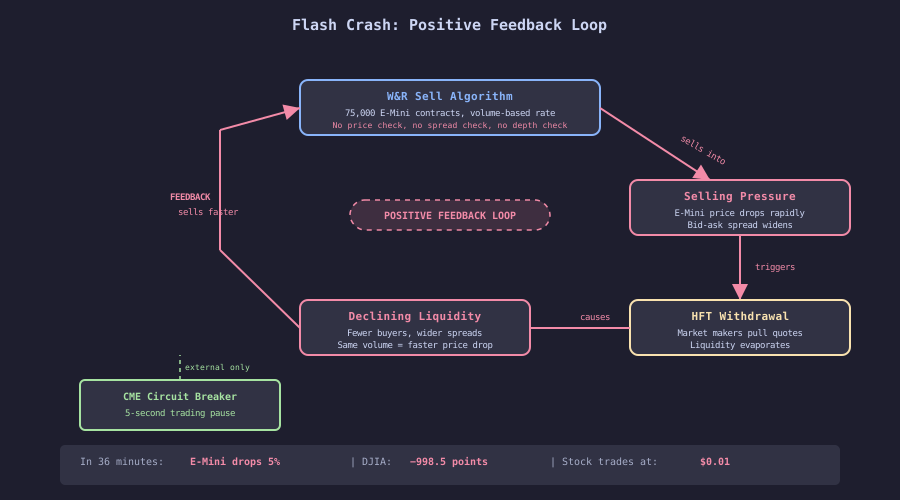
The diagram shows the positive feedback loop at the center of the crash. The sell algorithm increases selling in response to volume. HFT withdrawal reduces depth. Reduced depth increases price impact per unit sold. Increased price movement triggers more HFT withdrawal. The loop accelerates until the circuit breaker interrupts it. The circuit breaker is the only external force that breaks the cycle.