Reading Code Is the Job: Cognitive Load, Working Memory, and the Metric That Predicts Maintenance Cost
Reading Code Is the Job
A senior engineer joins the logistics platform team. They have ten years of Java experience, a track record of shipping complex systems, and a deep understanding of Spring Boot. They are given their first task: add a new carrier integration for international shipments. Three weeks later, they have made no meaningful progress.
The codebase has 200,000 lines of Java. It compiles. Tests pass. SonarQube reports acceptable metrics. The CI pipeline is green. And yet this experienced engineer cannot find where carrier integrations happen. The ShipmentService class is 3,400 lines long and handles everything from rate calculation to label generation to tracking event processing. The model package contains 87 classes, all public, and 60 of them import each other. The method they need to modify is called processShipment, which calls handleCarrier, which calls processData, which calls doWork. Each method name tells them nothing about what it does. Each call site requires reading the implementation to understand the contract.
This is not a problem that better tooling solves. The engineer’s IDE works fine. Autocomplete works. Find References works. The problem is that understanding any single piece of this codebase requires holding too many other pieces in working memory simultaneously. The architecture provides no isolation. The names provide no guidance. The boundaries provide no containment.
This book is about reducing that burden.
Working Memory Is the Bottleneck
Human working memory holds roughly four independent chunks of information at a time. This is not a metaphor. It is a well-documented constraint from cognitive psychology research, and it applies directly to reading code.
When a developer opens a method, they begin loading chunks into working memory: the method’s purpose, the types of its parameters, the meaning of local variables, the contract of called methods, the invariants of the enclosing class, the state that might have changed before this method was reached. Each of these consumes a slot. When the number of chunks exceeds four, the developer starts losing track. They re-read lines they already read. They scroll back to check a variable’s type. They open a called method to remember what it returns.
The logistics platform’s processShipment method requires a reader to hold these chunks simultaneously:
- Which of the six
statusenum values the shipment currently has, and which transitions are valid - Whether
carrierConfigwas loaded from the database or from a cache, because the method behaves differently in each case - The meaning of the boolean parameter
isRetry, which changes control flow in three places - Which of the four nested
ifblocks applies to international versus domestic shipments - Whether the
rateCalculationvariable was already populated by a previous conditional branch - The side effects of
notifyWarehouse(), which sometimes updates the shipment status directly
Six chunks. The developer’s working memory is already overflowed, and they have not yet reached the carrier-specific logic they came to modify.
Cognitive load in code reading has three components, borrowed from instructional design theory:
Intrinsic load comes from the inherent complexity of the problem. Carrier integration involves rate calculation, label formats, tracking event mapping, and error handling. This complexity is real and irreducible. Good code does not eliminate it. Good code presents it in pieces small enough that each piece fits in working memory without requiring the reader to hold the others.
Extraneous load comes from how the code is organized, named, and structured. Every time a reader must remember that processData actually means “validate and transform the shipment address,” that is extraneous load. Every time they must check whether a class is stateless or stateful because the name does not tell them, that is extraneous load. Every time they must trace through three layers of indirection to find the actual logic, that is extraneous load. This is the load that bad code adds on top of the problem’s inherent complexity.
Germane load comes from building mental models. When a reader encounters a well-named method in a well-bounded module, they build a reusable mental model: “the shipping.carrier package handles all carrier-specific logic, I can ignore it when working on billing.” That mental model reduces future cognitive load. It is the good kind of load. It is the kind of load that readable code produces.
The entire project of this book is reducing extraneous load and enabling germane load.
Why Traditional Metrics Miss the Point
Cyclomatic complexity counts decision points. A method with ten if statements has higher cyclomatic complexity than a method with two. This measures something real, but it is a proxy for what matters.
Consider two methods, both with cyclomatic complexity of 6:
// HARD TO READ: Cyclomatic complexity 6, cognitive complexity 22
// Every branch requires the reader to track accumulated state from previous branches
public BigDecimal processShipment(Shipment s, boolean isRetry, boolean isInternational) {
    BigDecimal rate = BigDecimal.ZERO;
    if (s.getWeight() > MAX_WEIGHT) {
        if (isInternational) {
            rate = calculateOversizeInternational(s);
            if (isRetry) {
                rate = rate.multiply(RETRY_DISCOUNT);
            }
        } else {
            rate = calculateOversizeDomestic(s);
        }
    } else {
        if (isInternational) {
            rate = calculateStandardInternational(s);
        } else {
            rate = calculateStandardDomestic(s);
            if (s.isPriority()) {
                rate = rate.add(PRIORITY_SURCHARGE);
            }
        }
    }
    return rate;
}
// READABLE: Cyclomatic complexity 6, cognitive complexity 8
// Each case is independent; the reader never carries state across branches
public BigDecimal calculateRate(Shipment shipment) {
ShipmentCategory category = ShipmentCategory.of(shipment);
return switch (category) {
case OVERSIZE_INTERNATIONAL -> calculateOversizeInternational(shipment);
case OVERSIZE_DOMESTIC -> calculateOversizeDomestic(shipment);
case STANDARD_INTERNATIONAL -> calculateStandardInternational(shipment);
case STANDARD_DOMESTIC -> calculateStandardDomestic(shipment);
case PRIORITY_DOMESTIC -> calculatePriorityDomestic(shipment);
};
}Same cyclomatic complexity. Radically different cognitive load. The first method requires the reader to track which branches have been entered, which variables have been modified, and what the boolean parameters mean at each point. The second method requires the reader to understand one concept: a shipment has a category, and each category has a rate calculation. One chunk of working memory instead of five.
SonarQube’s cognitive complexity metric is better than cyclomatic complexity because it penalizes nesting. The first method above scores 22 on SonarQube’s scale. The second scores 8. The threshold that predicts review difficulty is 15. But even cognitive complexity is a proxy. It counts structural patterns. It cannot measure whether a name communicates its purpose. It cannot measure whether a package boundary contains the right responsibilities. It cannot measure whether a reader needs to open four files or one to understand a change.
Lines of code counts volume. Coupling metrics count dependencies. Neither tells you how much a reader must hold in working memory. A 50-line method with clear names and no shared mutable state can be easier to read than a 10-line method that relies on three fields modified by other methods. A class with twelve dependencies can be easier to understand than a class with two dependencies if those twelve dependencies each have a clear, narrow contract.
The metrics are useful as signals. They are not the thing you are optimizing for. The thing you are optimizing for is how quickly a competent engineer can read a piece of code, understand what it does, and change it without breaking something else.
The Logistics Platform
Every chapter in this book uses the same codebase: a logistics management platform called LogiTrack. The system manages:
- Shipment tracking: Creating shipments, assigning carriers, tracking status through pickup, transit, customs, and delivery
- Warehouse inventory: Stock levels, bin locations, pick-pack-ship workflows
- Carrier integration: Rate calculation, label generation, tracking event ingestion for UPS, FedEx, DHL, and regional carriers
- Billing: Invoice generation, rate reconciliation, dispute handling
- Reporting: Delivery performance metrics, carrier comparison, cost analysis
The codebase is a Spring Boot monolith. It was built incrementally over several years by a rotating team. The original architects left. The design documents are outdated. The code works, but every new feature takes longer than the previous one, and every developer who joins the team takes longer to become productive than the last.
The package structure looks like this:
com.logitrack
├── controller/       (42 classes)
├── service/          (67 classes)
├── repository/       (38 classes)
├── model/            (87 classes)
├── dto/              (54 classes)
├── util/             (23 classes)
├── config/           (12 classes)
└── exception/        (15 classes)
Every class is public. Every package imports every other package. The service package contains classes for shipment tracking, inventory management, billing, carrier integration, and reporting. A developer working on carrier rate calculation must understand that ShipmentService calls CarrierService which calls RateService which calls ShipmentService again for shipment dimensions. The dependency graph is cyclic. The package names describe implementation layers, not business capabilities. Nothing in the structure tells a reader which classes are related or which can be safely ignored.
This is the codebase we will improve, one chapter at a time.
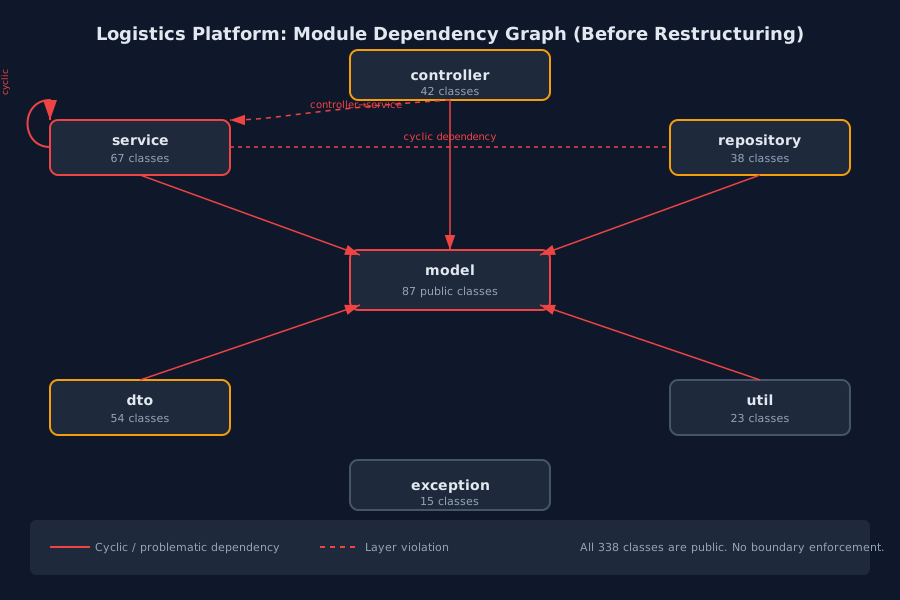
This diagram shows the dependency graph of the logistics platform before any restructuring. Every service depends on every other service. The circular dependencies between ShipmentService, CarrierService, and RateService mean that a change to any one of them requires understanding all three. The model package sits at the center with 87 public classes, imported by every other package. There is no modularity here. The architecture diagram and the actual dependency graph tell two different stories.
The Four Commitments
This book makes four commitments and holds to them in every chapter.
First: cognitive load is the metric. Every technique is evaluated by whether it reduces the number of chunks a reader must hold in working memory. If a refactoring satisfies a design principle but increases the number of files a reader must open to understand a change, it fails this test. If a naming convention is consistent but requires reading the implementation to understand the name, it fails this test.
Second: naming is design. A bad name is not a cosmetic problem. It is evidence that the code’s responsibilities are unclear. Chapter 3 and Chapter 4 use naming as a diagnostic tool: when a method resists a clear name, the method is doing too many things. When a class resists a clear name, the class spans too many concepts. The name is the symptom. The design is the disease.
Third: module boundaries are architecture. Chapter 5 and Chapter 6 reorganize the logistics platform from layer-based packages to feature-based modules with enforced boundaries. The test is whether a new developer can understand the shipment tracking module without reading the billing module. If they cannot, the boundary is not real.
Fourth: review culture is the enforcement mechanism. Chapter 8 covers code review as an engineering discipline. Automated tools catch style violations and complexity thresholds. Human review catches design drift, naming decay, and boundary violations. A team that reviews for cognitive load improves continuously. A team that approves to avoid friction accumulates the debt no tool can detect.
These four commitments are not principles to admire. They are decision rules to apply. Every section in this book ends with a rule concrete enough to use in a code review comment tomorrow.